
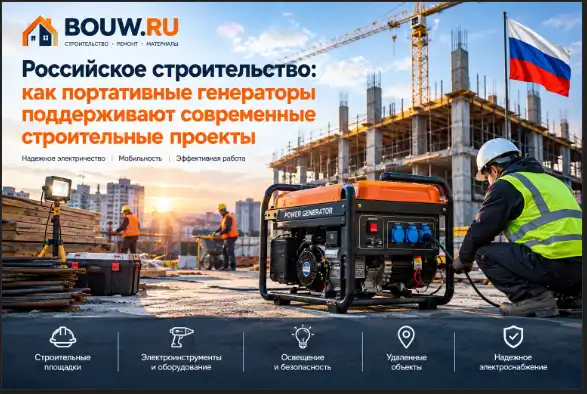
Construction projects depend on reliable access to electricity for tools, lighting, communication equipment, and other essential systems. On many construction sites, however, a permanent electrical connection may not yet be available or may not provide enough flexibility for changing work areas. Portable generators can provide an independent source of electricity that can be moved as the project develops.
For Russian construction projects, portable generators can be useful in residential construction, renovation, infrastructure work, remote locations, and temporary work areas. Their portability allows workers to bring electrical power closer to where it is actually needed.
Why Portable Generators Matter on Construction Sites
Construction sites can change significantly from one stage to another. Workers may begin with foundation work in one area and later move toward structural, roofing, finishing, or exterior work. A fixed electrical source may not always be located near the current working area.
A portable generator can help provide power for compatible equipment such as:
- Electric drills and other hand tools
- Construction lighting
- Battery chargers
- Small pumps
- Measuring and testing equipment
- Laptops and communication devices
- Other electrical tools within the generator’s rated capacity
The generator should always be selected according to the actual power requirements of the equipment being used.
Portable Power for Remote Construction Locations
Some construction projects take place outside major urban areas where access to the electrical grid can be limited. This can include country houses, warehouses, agricultural buildings, road-related projects, and temporary construction sites.
In these situations, portable generators can provide flexibility because they can be transported between different work areas. This can help construction teams maintain access to electricity without waiting for a permanent connection to be completed.
For remote projects, practical considerations include fuel availability, generator capacity, transportation, operating conditions, and the total electrical load expected during daily work.
Choosing the Right Generator for Construction Work
The correct generator should be selected according to the type and quantity of equipment that needs electricity. Simply choosing the largest available generator is not always the most practical approach.
Important factors include:
- Power output: The generator should provide enough continuous power for the connected equipment.
- Starting power: Some equipment can require additional power when starting.
- Fuel type: Petrol and diesel models have different operating characteristics and applications.
- Portability: Wheels, handles, and overall dimensions can matter when the generator needs to be moved frequently.
- Runtime: Longer operating periods may require a suitable fuel-tank capacity.
- Operating environment: Dust, moisture, temperature, and ventilation should be considered.
Understanding these factors can help construction teams choose equipment that matches their actual working conditions.
Generators and Construction Site Lighting
Good lighting is important when construction work continues during low-light conditions or inside unfinished buildings. Portable generators can provide electricity for compatible temporary lighting systems.
Lighting can be particularly useful in basements, workshops, storage areas, exterior work zones, and buildings where permanent electrical systems have not yet been completed.
LED lighting can also be considered because efficient lighting can reduce electrical consumption and allow available generator capacity to be used for other equipment.
Electrical Safety on Construction Sites
Electricity requires careful handling on every construction site. A generator should be installed and operated according to its manufacturer’s instructions and applicable safety requirements.
Construction teams should pay attention to:
- Proper grounding and electrical protection
- Suitable cables and connectors
- Protection from rain and excessive moisture
- Adequate ventilation
- Correct generator loading
- Safe fuel storage and handling
- Regular inspection of electrical connections
Portable generators should also be positioned in an appropriate location to reduce risks associated with exhaust gases, heat, fuel, and accidental contact.
Portable Generators During Renovation Projects
Generators are useful not only for new construction but also for renovation and repair projects. During renovation, electrical systems may be temporarily disconnected while walls, floors, ceilings, wiring, or other building components are being changed.
A portable generator can provide temporary electricity for suitable tools and lighting during these stages. This makes it possible to continue certain work without depending completely on the building’s existing electrical system.
This application fits naturally within the broader Russian construction and renovation market, where residential properties, country houses, garages, and other structures may require electrical tools during different stages of improvement.
Improving Construction Workflow With Portable Power
Portable electricity can make a construction site more flexible because workers can move power closer to the area where work is taking place. This can be particularly useful when several parts of a project are being completed simultaneously.
A well-planned power setup can help organize tools, lighting, charging equipment, and other electrical loads more efficiently. However, the generator’s rated capacity should always be considered before connecting multiple devices.
Planning the electrical load in advance can also help prevent unnecessary overloads and improve the practical use of available power.
The Role of Portable Generators in Modern Construction
Construction is becoming increasingly dependent on electrical tools, battery-powered equipment, digital devices, lighting systems, and specialized machinery. As projects become more flexible, temporary and mobile power solutions can play an important supporting role.
Portable generators provide one approach to this challenge. They can be transported, positioned near working areas, and used where a permanent electrical connection is unavailable or temporarily unsuitable.
For construction companies, contractors, and individual builders, selecting the appropriate generator based on actual requirements is an important part of planning temporary power on a site.
Conclusion
Portable generators can provide valuable electrical support for construction, renovation, and remote building projects. Their mobility allows power to be available in different working areas, while different generator capacities make it possible to select equipment according to the project’s electrical requirements.
From tools and temporary lighting to charging equipment and communication devices, portable generators can support many construction activities when used within their rated limits. For Russian construction projects, careful selection, safe installation, proper load management, and regular maintenance can help make portable power a practical part of modern construction-site planning.