
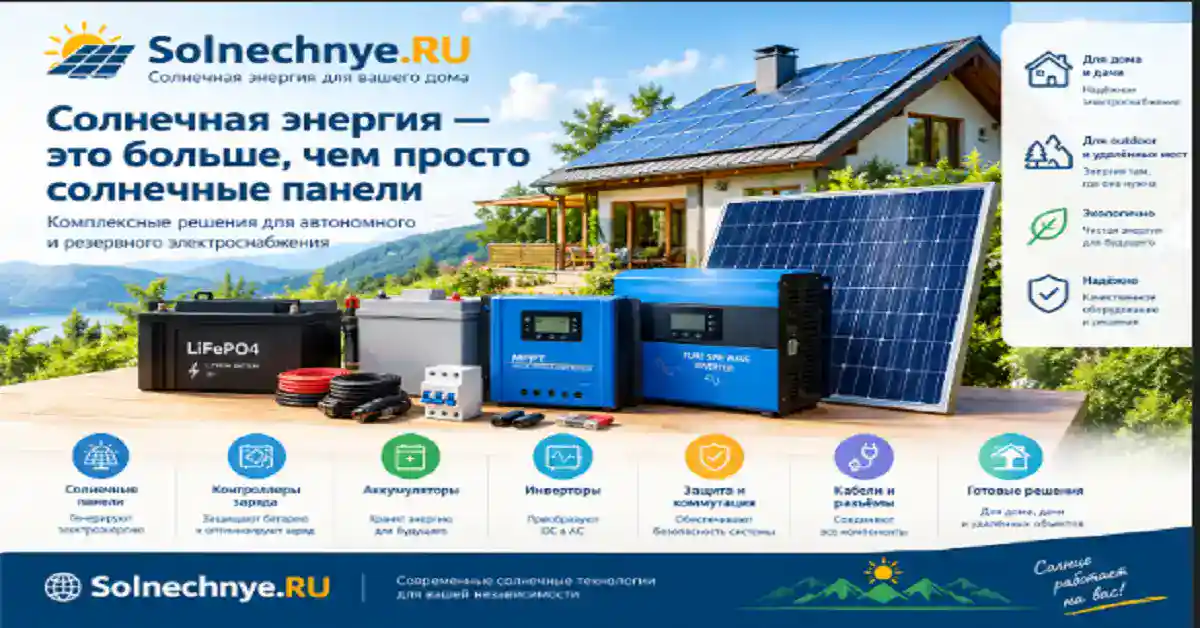
Solar energy has moved from being a specialised technology to a practical option for homes, cottages, remote locations, and backup power systems. A modern solar installation is not simply a collection of panels. It is a complete energy system that can include solar batteries, charge controllers, accumulators, inverters, protection equipment, and other components working together.
Solnechnye.RU is focused on equipment for using solar energy, including solar batteries, ready-made solutions, charge controllers, accumulators, inverters, chargers, and solar water-heating equipment. The website also provides information for people interested in selecting components for autonomous and backup power systems.
Why Solar Energy Requires More Than Solar Panels
Solar Panels Are Only the Starting Point
Solar panels convert sunlight into electrical energy, but they are only one part of a complete system. The electricity produced by the panels needs to be managed, stored, converted, and delivered to the devices that require power.
The correct combination of components therefore matters as much as the panels themselves.
Energy Storage Improves Flexibility
Batteries allow generated electricity to be stored for later use. This can be particularly useful when energy is needed after sunset or when sunlight is temporarily limited.
The appropriate battery capacity depends on the expected load, system design, and required operating time.
Inverters Connect Solar Power With Everyday Loads
Many household appliances operate on alternating current, while solar batteries and storage systems commonly work with direct current. An inverter performs the necessary conversion between these electrical forms.
For this reason, inverter selection should be considered together with the solar panels, batteries, expected loads, and system voltage.
The Importance of a Proper Charge Controller
Controlling the Charging Process
A charge controller manages the charging process between solar panels and a battery. Solnechnye.RU describes charge controllers as an important part of a solar power system because they control charging voltage and other charging parameters.
Without appropriate charging management, a system may not use its battery efficiently or safely.
PWM and MPPT Technologies
Different charge-controller technologies are designed for different applications. PWM and MPPT are two common approaches used in solar installations.
The correct choice depends on the configuration of the solar panels, battery voltage, system requirements, and desired performance.
Battery Type Also Matters
Different battery technologies have different charging characteristics. The controller therefore needs to be compatible with the battery being used.
Solnechnye.RU’s technical material notes that quality controllers can account for factors such as battery temperature and battery type when managing charging.
Designing Solar Systems for Real-World Use
Start With Actual Energy Consumption
A solar system should be designed around the electricity that users actually need. Important questions include which appliances will operate, how long they will run, and whether power is required continuously or only during particular periods.
This approach is more practical than selecting equipment based only on the highest available panel rating.
Consider Peak Loads
Some electrical appliances require considerably more power when starting than during normal operation. Motors, pumps, refrigerators, and certain tools can create temporary peak demands.
The inverter and battery system should therefore be evaluated against both normal and starting requirements.
Allow for Changing Conditions
Solar generation varies according to sunlight conditions, season, panel orientation, shading, and other environmental factors.
A realistic system design takes these variations into account instead of assuming that panels will produce their maximum rated output throughout the day.
Solar Batteries and Energy Independence
Storing Electricity for Later
Battery storage changes the way solar energy can be used. Instead of consuming every unit of generated electricity immediately, excess energy can be stored for later.
This makes solar systems more flexible for homes and other locations where electricity is needed at different times of the day.
Backup Power Applications
Solar systems can also be designed for backup electricity. Solnechnye.RU offers equipment and ready-made solutions for autonomous and reserve power systems for homes and country properties.
Such systems can be configured according to the loads that users consider most important during a power interruption.
Mobile and Remote Applications
Solar energy can also be useful in locations where conventional grid electricity is unavailable or difficult to access.
With suitable panels, batteries, controllers, and inverters, a properly designed system can provide electricity for selected loads in remote environments.
Choosing Components as One Complete System
Match the Panel and Controller
The electrical characteristics of solar panels should be compatible with the selected charge controller. Voltage, current, system voltage, and total panel capacity all need to be considered.
Solnechnye.RU provides controllers designed for different battery voltages and solar-panel configurations.
Match the Battery and Inverter
The battery bank needs sufficient capacity for the intended load, while the inverter needs to support the required operating power.
A mismatch can limit system performance even when individual components are technically high quality.
Use Appropriate Protection
Solar installations also require suitable protection equipment, wiring, connectors, fuses, and circuit protection.
Ready-made solar solutions listed by Solnechnye.RU include components such as solar panels, charge controllers, inverters, batteries, fuses, cables, and connectors.
Practical Solar Energy for Homes and Outdoor Locations
Homes and Country Properties
Residential solar systems can be designed for different purposes, from supporting selected household appliances to providing autonomous electricity.
The required configuration depends on electricity consumption and the level of independence required from the conventional grid.
Outdoor and Remote Energy
Solar power can also be useful for outdoor locations where access to conventional electricity is limited. Lighting, communication equipment, small appliances, and other selected loads can potentially be supported through appropriately designed systems.
The important factor is matching the available generation and storage capacity with actual energy requirements.
Planning for Different Weather Conditions
A solar system should not be designed around ideal sunlight conditions alone. Cloud cover and seasonal changes can affect energy production.
Battery capacity and backup arrangements can therefore play an important role when consistent electricity availability is required.
Building a More Reliable Solar Power Strategy
Think About the Complete Energy Chain
A practical solar system can be viewed as a chain:
Solar panels → Charge controller → Battery → Inverter → Electrical loads
Each component has a specific function, and the system performs best when those components are selected as a coordinated set.
Select Equipment According to Requirements
There is no single solar configuration that works equally well for every property. A small backup system and a large autonomous installation have very different requirements.
Solnechnye.RU provides both individual components and ready-made solar solutions, allowing systems to be considered according to particular energy requirements.
Focus on Long-Term Practicality
A solar installation should be evaluated not only by its initial price but also by compatibility, reliability, storage capacity, maintenance requirements, and expected usage.
Choosing appropriate components from the beginning can help create a system that is easier to operate and expand when energy requirements change.
| Solar Component | Main Function | Key Point to Consider |
|---|---|---|
| Solar Panels | Generate electricity from sunlight | Power, voltage, orientation, and available sunlight |
| Charge Controller | Manages battery charging | PWM/MPPT type and battery compatibility |
| Battery | Stores generated electricity | Capacity, technology, and required backup duration |
| Inverter | Converts DC electricity for AC loads | Continuous and peak power requirements |
| Protection Equipment | Helps protect the electrical system | Appropriate ratings and system configuration |
| Cables & Connectors | Connect system components | Correct size and compatibility |
| Ready-Made System | Combines multiple components | Match the package to actual energy needs |
Conclusion
Solar energy becomes much more practical when it is treated as a complete electrical system rather than simply a collection of solar panels. Panels, charge controllers, batteries, inverters, protection devices, and wiring all have important roles, and their compatibility can influence the performance of the overall installation.
The information and equipment offered through Solnechnye.RU reflect this broader approach, with solar batteries, controllers, accumulators, inverters, ready-made solutions, and other solar-energy products available for autonomous and backup applications.
For homeowners, outdoor users, and people planning independent energy systems, the most valuable step is to begin with actual electricity requirements and then select components around those needs. A properly planned solar system can provide a practical way to generate, store, and use renewable electricity while giving users greater flexibility over how their energy is supplied.